Thursday, October 28, 2010

For LGBT teens who have considered suicide

The folks at Lambda Literary asked me to compile a list of 10 LGBT novels for teens that deal with suicide  and bullying. With the recent tragic suicides of gay teens, I hope this list will be a resource for young people and adults. The list includes books by such notables as Alex Sanchez and Kate Bornstein, and new books that definitely deserve your attention. You can read the article at this link.

Monday, October 25, 2010

Party out of bounds

Last night's Twitter Poet Party was lively, chaotic and fun. I had never participated in a Twitter chat before, although many groups have them regularly. With more than 600 tweets in an hour from the participating poets and party-goers, the messages were coming fast and furious. I used Hootsuite to set up a dedicated stream for the #poetparty hashtag, which helped me keep up with the conversations. You can read the transcript at the 32 poems blog at this link.

D.A. Powell (@powell_da), January O'Neil (@januaryoneil), Aimee Nezhukumatathil (@aimeenez), Susan Rich (@susanrichpoet), Oliver de la Paz (@Oliver_delaPaz), Kelli Russell Agodon (@kelliagodon) and me (@collinkelley) were the poets invited by Deborah Ager from 32 poems (@32poems) to take part. We had some fabulous lurkers, too, like Karen Head (@poetphd), Shann Palmer (@shannpalmer) and Anne Haines (@annehaines) among many others.

Each of the poets contributed a line from one of their own poems, a line from a favorite poem by someone else, talked about organizing a collection for publication, mentors, social activism and shared links to useful sites. It's amazing how much information can be shared in an hour with just 140 characters. It also shows the power of Twitter as a tribe and community builder of like-minded folks. 

While we were tweeting away, D.A. Powell was constructing a poem from some of our tweets. You can read the poem and Kelli Agodon's wrap up at her blog, Book of Kells

Poetry and Twitter have become intertwined for me since I posted the Poets on Twitter list on my blog in May 2009 (and the follow up 2.0 list) later on, not to mention editing the special Twitter issue of OCHO magazine. January O'Neil said it's time for me to suck it up and get a 3.0 list together. I'm moving it to the top of my project list. 

Sunday, October 24, 2010

Twitter Poet Party Tonight!

If you happen to be on Twitter tonight (Oct. 24) at 9 p.m. eastern time, look for a virtual poetry reading and book discussion between me (@collinkelley), Deborah Ager from 32 poems (@32poems), D.A. Powell (@powell_da), January O'Neil (@januaryoneil), Aimee Nezhukumatathil (@aimeenez), Susan Rich (@susanrichpoet) and Kelli Russell Agodon (@kelliagodon). We'll be using the hashtag #poetparty so find us on Twitter and join in.

Friday, October 22, 2010

Photos at an exhibition

I refuse to write when I'm not in the mood. I know many force themselves to sit in front of a computer screen or write in a notebook to keep up the "discipline," but that has never worked for me. If I can't write, I'd rather be reading, or watching House Hunters International on HGTV or scrolling through Facebook.

A new poem had been rattling around in my mind for the last couple of weeks – actually a few months, but more on that in a minute – but I wasn't in the mood to write it. Last night, I was just going to jot down the lines I had sorted out in my head before I lost them in a fog of other thoughts, but three hours later I had a first draft.

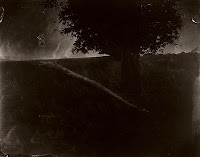
The idea for the poem came from the Sally Mann exhibition at The Photographer's Gallery in London. I thought the poem was going to hinge on a comment Karen Head made while we were looking at Mann's Immediate Family portraits: "She's the Sharon Olds of photography." Mann's photos of her young children in various states of controversial nudity still pack a punch, but it was the set of images from What Remains – photos of decomposing corpses at the The University of Tennessee Anthropological Research Facility and the Civil War battlefield at Antietam (pictured) – that stuck with me.

Mann often uses the old wet-plate collodion method for her photography, where a glass plate is coated in chemicals, exposed and then rushed to a make-shift darkroom to process. The irregularities and unexpected textures of the collodion – not to mention errant dust and debris – make for arresting, ethereal black and white images. I read and watched videos on the collodion process for about 90 minutes and then started writing.

I've never written a poem quite like this one, so I've starting sending it around to some trusted friends for their feedback. It's too technical at the moment, but I think it has good bones. I need to let it sit for awhile and then come back to it.

If that wasn't enough, I then started tweaking a couple of other recent poems and before I knew it was midnight. If only I could get on that kind of roll with the Conquering Venus sequel. The last three chapters are coming in fits and starts – despite the outline.

If you happen to be on Twitter this Sunday night (Oct. 24) at 9 p.m. eastern time, look for a poetry discussion between me (@collinkelley), Deborah Ager from 32 poems (@32poems), D.A. Powell (@powell_da), January O'Neil (@januaryoneil) and Aimee Nezhukumatathil (@aimeenez). We'll be using the hashtag #poetparty so find us on Twitter and join in.

Wednesday, October 20, 2010

The color purple

Wear purple today to raise awareness of anti-gay bullying and those we have lost to suicide. Franklin Abbott's poem, "You Cannot Kill Me," is the meditation for the day. Read it here at The GA Voice.

Sunday, October 17, 2010

AQLF weekend wrap-up

It's been an exhausting four days, but the 2010 Atlanta Queer Literary Festival was a success. You can see a photo gallery at the AQLF site now.

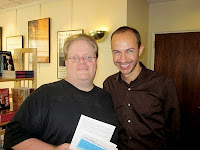
I hosted the opening night event at Charis Books and moderated two panels and read poetry with Steven Reigns yesterday at the Decatur Library (that's me and Steven in the photo). It was great to see and hear so many fine folks including keynote speaker Cary Alan Johnson, Jonathan Lerner, Joanna Hoffman, Amy King and Janet Mason among many others. Speaking of the keynote address, if you missed it on Friday night you can watch the video now at this link.

I enjoyed hanging out with Steven and catching up on our lives and career. My sofa is yours anytime. Events like this also inspire me to write and create. I did a little of that today, including putting some lines down for a new poem. I'm sending love, affection and thanks to my fellow AQLF coordinators -- Franklin Abbott, Megan Volpert and Cleo Creech -- who helped keep the festival on track and running smoothly.

Now that the festival is over, I'm turning my attention to Voices Carry on Oct. 30 at Sycamore Place Gallery in Decatur. This will be the seventh annual reading and I am thrilled to be reading with Natasha Trethewey, Patrick Donnelly, Richard Garcia, Ayodele Heath and my pal Cecilia Woloch. Mark you calendar now and find out more about the reading at this link.

Vanilla Heart Publishing has made Conquering Venus available in ebook format direct from VHP Instant Download. You can buy Venus and any VHP title for just $4.99!

Friday, October 15, 2010

AQLF 2010 photos

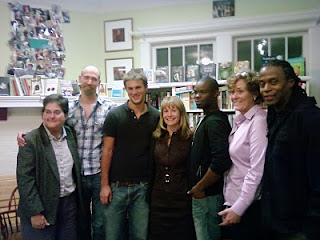
Alice Teeter, Timothy Wright, Bailey Lynn, Karen Head, Antron-Reshaud, Maudelle Driskell and Mose Hardin performed at the opening night event on Wednesday at Charis Books in Little Five Points.
Poet Joanna Hoffman performed last night during the AQLF Jewish Showcase at Outwrite Books along with Jonathan Lerner and Megan Volpert.

Wednesday, October 13, 2010

AQLF 2010 begins tonight

The 2010 Atlanta Queer Literary Festival kicks off tonight at 7 p.m. at Charis Books and More in Little Five Points with a reading by some of Atlanta's most talented LGBT voices. The line-up includes Karen Head, Maudelle Driskell, Alice Teeter, Timothy Wright, Phyllis Free, Mose Hardin, Reginald Jackson, Antron-Reshaud and Bailey Lynn. I'm playing host. Charis is located at 1189 Euclid Avenue. The event is free!

For the complete schedule for this year's festival, click this link.

Monday, October 11, 2010

The weekend that was

On Friday, I left Atlanta at the crack of dawn for the four hour drive to Nashville. With the crossover into central time, I made it to the city with  more than an hour to spare for the opening of the Southern Festival of Books at noon. A roadtrip to Nashville is actually quite pleasant, since the expressway takes you around winding rivers and high up into the mountains where there are signs for "falling rock" and for truckers to use lower gears and keep to the right.

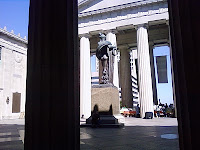
The festival was held in War Memorial Plaza, pictured, and the capital building in the heart of downtown Nashville. It's a lovely spot. The plaza was full of booths from indie presses and literary organizations and the festival bookstore was laid out between the columns that lead up to the Tennessee State Museum and the War Memorial Auditorium.

My reading was in the cabinet rooms underneath the plaza. I read with two other novelists, Mark Heinz (Shine) and Leanna Sain (Gate to Nowhere). Our event was appropriately titled "Uniting the Unlikely: Three Debut Novels." Mark's novel is about moonshining in Kentucky, while Leanna's is a fantasy novel about a woman who find's a gate on her property that sends her back in time. And, of course, there's my Conquering Venus, which you already know about. Don't you?

Our session got off to a disappointing start. There was no one to introduce us and a metal detector kept attendees waiting in line as they tried to get to the readings and panels in the plaza rooms. We only had a dozen or so folks for our reading, so we gathered around the big conference table and talked about our books and gave short readings. The host never materialized to walk us over to the "signing colonnade" so we wandered over there ourselves. I think we each sold one book.

Book festivals are tricky and often disappointing, especially if you're a first-time author. There are so many competing events and, chances are, no one knows or cares who you are. I've done enough readings from my poetry collections and Venus that low turnout doesn't faze me anymore. There were four or five high school students in our session and they asked some thoughtful questions.

It was a beautiful day in Nashville, so I wandered around the booths for a bit and then checked into the hotel for a nap and to catch up on work email. I phoned up the fab poet Jilly Dybka and we made plans to meet for dinner and to see the restored version of Metropolis as the historic Belcourt Theatre (a former home of the Grand Ole Opry). "The Complete Metropolis," as it's billed, features 25 minutes of footage thought lost and this special screening was accompanied by the Alloy Orchestra. The old Belcourt is a stunning old theater and seeing Metropolis on the big screen the way Fritz Lang intended it (not to mention the brilliant score from the Alloy) was a thrill. It was a sold out screening and the audience gave the film and orchestra a standing ovation at the end.

On Saturday morning, I returned to the festival to hear Ron Rash and Rick Bragg (excellent readings and big audiences) and then it was time to head home. The drive was quick, but by the time I arrived I was exhausted.

Starting Wednesday night, the Atlanta Queer Literary Festival kicks off. Come out and join us!

Thursday, October 07, 2010

Southern Festival of Books & AQLF

I'll be at the Southern Festival of Books this weekend in Nashville. My reading is at high noon on Friday in Room 30 at War Memorial Plaza. I'll be reading from and signing Conquering Venus, so if you happen to be in town, drop by and say hello.

Next week, the fourth annual Atlanta Queer Literary Festival is Oct. 13-16. I'll be hosting the opening night event at Charis Books on Wednesday at 7:30 p.m., moderating journalism and social media panels and giving a short poetry reading on Saturday at the Decatur Library. This year's festival is going to be diverse, so check out the full schedule at this link.

More soon!

Wednesday, October 06, 2010

An Interview with Jackie Sheeler, Part 2


The second  part of my interview with poet Jackie Sheeler is multimedia. Two poems from the excellent new collection, Earthquake Came to Harlem, plus video of her performing "The Scissors of My Mother" this past Friday night at The Bowery Poetry Club in New York and a second audio clip. It's full Sheeler immersion here at Modern Confessional

Another Hallway Altar In The Projects

One haggard afternoon lifted its funeral skirts,
tucked a gradeschool girl underneath—
Now you see her. Now you don’t:
blood in the hallway again.

Custodian, bring out the homicide mop.

One minute of thrusting.
One busted windpipe, one
pale thimbleful of crackhead semen
(he needed to squeeze his dick into her so bad…)

Project shrines blossom overnight—
photographs and cheap dolls
flicker of votives over stained tiles,
a bloody mop beside the slop sink,

the perfume of ammonia in the air.


The Maker

God made AIDS, and gave it to himself in Greenwich
Village, while examining holy germhood
through the eyes of his microscope self.

God made the ocean to sit beside
on the night he was bereft, seeking
comfort in the rhythms of his largeness.

God made the Trade Center
because he needed a place to watch the city
over good food late at night with rich companions
and a place to aim his flaming planes.

God sits beside me on the brownstone stoop,
with one hand on my face, one hand on a trigger.
He pulls up my blanket and slams shut a cell.

His love is everywhere, bright as radium,
potent as a payload.


Tuesday, October 05, 2010

Blogger issues

I've received emails from several of you who have tried to leave comments in the last few days that the CAPTCHA (or word verification) is not working or you're getting a "service error" message. Blogger is having serious issues with the platform right now. There have been intermittent outages, issues with uploading photos and other annoyances. Google says it's aware of the problem. I'm going to try removing word verification for now and see if that helps, although I'm sure the comment spammers will find their way in.

I'm going to wait a a day and post part two of my interview with Jackie Sheeler, so look for it on Wednesday. Also, if you follow me on Facebook, all the blog posts get posted on my wall, so leave a comment there if you can't do it here.

UPDATE TO UPDATE: It appears now that even if you can leave a comment, it either won't show up on the blog or it takes half an hour or more to post. I will continue to post and hope you'll keep reading while Google sorts itself out. I'm starting to second-guess not moving to WordPress.

Monday, October 04, 2010

An Interview with Jackie Sheeler, Part 1

I met Jackie Sheeler seven years ago when she invited me to New York to read at the Pink Pony series at Cornelia Street Cafe. Jackie and I clicked instantly – over politics, poetry and a deep sense of do-it-yourself energy when it comes to getting our work in front of audiences. While getting to know Jackie as a  friend, I also became a fan.  I loved her debut collection, The Memory Factory, and every time she released an album or single with her band, Talk Engine, it was always on the stereo.

The poems in Jackie's new collection, Earthquake Came to Harlem (NYC Quarterly Books) are a blow to the head and heart; the work is raw, gritty but also finely crafted. She pulls no punches when talking about being raped as a child, her dysfunctional family and descent into heroin abuse. And while those could be conventional tropes in other hands, Jackie wrestles them into compelling, lyrical poetry that grabs you from page one.

The following is part one of a two part feature on Jackie. Today's post is an interview and a live, musical version of "Meeting Patti Smith in Brooklyn." Tomorrow, there will be another live performance and one of my favorite poems from Earthquake Came to Harlem.


Let’s talk about the title of the collection and the title poem; the poem seems like a fantasia, a fever dream and, to me, it reads differently than the other poems in the book. Talk about that poem, the inspiration and why you chose it for the title.

That poem is relatively recent, and was written after a series of earthquakes in various countries around the world. I wondered what it would be like to have an earthquake in NYC, and the poem sprang from that wondering. The final version is part of what was a much longer piece envisioning earthquakes in various neighborhoods – from midtown to Canarsie – with shopkeepers trying to open their stores with roll-gates crashing down behind them, and so forth. The Harlem sequence is the first one, and was one of those pieces that seemed to write itself; the other sections seemed weak in comparison, so I scrapped them. That poem is linked, in a way, to the final poem of the book, “Teenage Roommate,” which is a direct narrative of my vision of impending global collapse. In "Earthquake," rather than making predictions, I simply observe the collapse.

Using Earthquake Came to Harlem as the title was suggested by a friend, the fabulous writer Shelley Stenhouse, and the idea clicked immediately. There’s almost a tongue-in-cheek aspect to it, as if I am the “earthquake” that came to Harlem, and in a certain sense that’s exactly right, exactly how it feels. I’ve lived here for nine years now, longer than I’ve lived any other place in my life (including childhood homes). I keep returning to the neighborhood and my neighbors in poems, many of which appear in the book.

I’m particularly struck by the section called “Diorama” about the abuse from your mother, your absent father, the rape you survived. The typical definition of diorama is to make a model reduced in scale so you can see it all in detail. The poems in the “Diorama” section are so finely observed yet never veer into victimization. How difficult was it to conjure up those details and convey something so intimate but also to remove yourself enough from the poems to allow readers to enter those dark places with you?

The biggest factor in being able to do that is time: many of the events of the “Diorama” poems took place decades ago, long enough to develop a bit of context (and a thicker skin). I don’t often write about events while they’re still “hot” for me, as that writing is usually not very good. I may do it as a personal exercise, to get something off my chest and “out of the pipeline,” but almost invariably those pieces are set aside, unedited – for that matter, they don’t even get typed up.

I’m careful not to conflate the importance of the content with the worth of the poem; and if I can’t tell, I’ll set it aside a bit longer, or just err on the side of caution and put “NT” at the top of the page – Not worth Typing. I’ve discarded far more poems over the years than I’ve completed, and completed far more than I’ve published. Not everything deserves to be published – or performed. I know this may come as a shock to some poets, who seem eager to publish every first draft on Facebook or a personal blog, or who come to open mics and preface the piece with “I just wrote this today and I have no idea if it’s any good.” Honey, if you have no idea whether or not it’s worth reading, then why are you reading it? Do your frigging work first.

Another aspect of being in touch with the dark side, without getting maudlin about it, has to do with my experiences in drug treatment programs and 12-step groups. In those settings, people relate the most horrific stories almost as if they’re telling…not quite a joke, but a story from another planet. I heard one young woman make a statement about her father turning her out as a prostitute at 14 (he was her first customer, to break her in), twisting the narrative until it became a series of wisecracks about what an asshole he was. She had the whole room laughing, but she wasn’t minimizing her suffering, she used humor to make it hers, to take it away from him and create a story she could live with rather than one that would keep her shooting dope in the basements of the Bronx. And it worked.

There’s a way in which writing a poem, a good one (we know when we have a good one, there’s that…click) about an awful event that’s alchemical in nature – literally turning shit to gold. Now, it’s not just a sad old tired old “yet another dysfunctional childhood” story but a piece of art, a work that may communicate strongly with certain others. There’s a satisfaction and joy in that which I haven’t found elsewhere.

Confessional poetry has always been the bane of formalists and old-school poets, but I’ve been hearing a lot more criticism lately that there is too much “I, I, I” and “me, me, me” in poetry – that poetry is becoming more and more like memoir. Your poems are what I call post-confessional or modern confessional because you really do let it all hang out. Do you spurn the confessional label or embrace it? Talk about being a confessional poet in 2010.

I spurn the label because of the epithetical and lopsided way that it is used. Why is it that Sharon Olds is called confessional but Charles Bukowski isn’t? Look at Galway Kinnell’s “When One Has Lived A Long Time Alone” and tell me where that great poem doesn’t fit the definition of confessional – yet he isn’t categorized as such. What about Gregory Orr’s poems about shooting his brother? Or Marie Howe?

Stanley Kunitz wrote that, “The transformation of individual experience – the transpersonalization of the persona, if you will – is work that the imagination has to do, its obligatory task. One of the problems with so much of what was called, in the '60s, confessional poetry was that it relied excessively on the exploitation of self, on the shock effect of raw experience. My conviction is that poetry is a legendary, not an anecdotal, art.” I take this to mean that his definition of confessional poetry is that which uses startling information for its own sake, and does not explore it, give it context or meaning or value through the lens and tools of poetry. That’s a definition I can agree with, but one that takes writers like Plath, Olds, Hoagland et al out of the confessional poet ghetto while placing writers like Bukowski squarely inside it.

I think most of my poems are better characterized as narrative than confessional, and narrative poetry in general is the poetry that touches me most deeply. Poets who don’t engage the “I,” or use an “I” so abstract as to be barely identifiable as human, don’t really interest me, though some of them may be quite adept with language. I’m thinking here of poets like Lucie Brock-Broido and Rae Armantrout, to a lesser extent Jorie Graham. While I can, as a writer, appreciate the dexterity and complexity of the way they shape language, I am rarely moved by their work, and seldom leave that kind of writing with a take-away. Whereas I’ll never forget the first Ellen Bass poem that I read, standing at the Strand Bookstore sale table. “Poem to My Sex at 51,” in Mules of Love. I read it and read it again and read it a third time and proceeded to buy every book of hers that I could find. (At that time, Mules was her most recent book; her latest book, The Human Line, has a poem in it that I still can’t read without weeping, though I’ve read it at least a hundred times, “Gate C51”.) I’ve yet to have that experience with any poet writing in the “language” style.

At risk of being drawn and quartered, I admit that sometimes I think language poetry is a case of the emperor wearing no clothes. Poets saying little or nothing, but saying it so densely and obscurely that readers are convinced they are simply too obtuse to get the point, and to avoid admitting that they jump on the accolade bandwagon.

Talk about your creation process – do you write every day, keep a notebook for thoughts and ideas? I know you’re an early riser – is that your “sweet spot” of the day for getting lines on the page?

I don’t write every day, except for occasional creative spurts, though I always tell myself that I should write every day. I am engaged with the creative process every day, in one way or another – either editing a piece, whether mine or someone else’s, reading a poem or hosting a reading. The last few years I’m doing a lot more songwriting, so guitar practice also plays a part in this process of daily connection with the creative force. I don’t really count blogging as writing, at least not the political blogging that I’ve mostly done – and, interestingly enough, that is the one kind of writing (apart from email) that I do generate using a keyboard rather than a pen and paper and that I can write while I’m still seething over the topic at hand. “Write it Cold” – which sits on a post-it in the middle of my bulletin board – is great advice for all writing other than blogging. When blogging, rant!

I keep a notebook, actually several ongoing notebooks at a time, and usually don’t leave the house without a pocketful of felt-tip pens. I love workshopping, because in that environment some kind of switch turns on. I might start half a dozen new pieces in the course of a weekend, and later find that half of them merit further attention. It’s been quite some time since I’ve been part of a regular critique workshop, though in the past I’ve been a member of two that started in a formal setting and enjoyed several years of life after that course ended. I hope to find another like that, as the weekly deadlines make me more productive, and the input of other writers with very different voices and perspectives can be incredibly helpful in unlocking a poem.

I’m very committed to the editing process; some poems are worked and reworked for a year or two before I consider them final; even then, even after being published, they may still be tweaked a time or two. For me, the concept of “first thought, best thought” does not apply to creative work; sometimes the final draft of a poem has almost nothing in common with the first, and almost invariably the later version is stronger. The rape poem is an interesting example of that – and it’s a poem I had no intention of writing in the first place. A poem from my first book was included in an anthology edited by Carly Sachs, The Why and Later, poems about rape. But I didn’t want to read that piece at the launch event, so I wrote something else, which turned out to be the kernel of “Bensonhurst 1971.” I knew that it wasn’t very strong as written, only strong enough to share at a reading dedicated to that subject. I wrote it, read it and thought that was the end of it until I started putting this book together, and compiled all my drafts and fragments and notes into one huge shitpile from which to choose the poems for the book.

Shelley Stenhouse worked closely with me through this process of selection, revision and ordering. I needed the eyes of a poet that I respected to help me see what I had. She kicked my ass! If not for her demanding but encouraging approach, several poems that are among the strongest in the book would never have achieved their final form or made it into the book at all. She picked “Bensonhurst 1971” from the slush pile as one worth working on, and under Shelley’s guidance (whip!) it went from a rough half-page sketch to what is now the longest poem I’ve ever published.


Friday, October 01, 2010

Gay teen bullying epidemic must stop

The suicide of 18-year-old Rutgers University student Tyler Clementi was a tragic close to a shocking month of gay teens taking their own lives because of their sexuality. Clementi's dormmate secretly (and illegally) recorded the teen having sex with another man, sent out messages on Twitter and broadcast it across the internet. Clementi, who was allegedly not out to his family, jumped from the George Washington Bridge.

In California, Seth Walsh, 13, hung himself after years of being bullied, but no charges will be filed and the school claims no culpability. In Texas, Asher Brown, also 13, shot himself in the head with his father's pistol after school officials refused to do anything about constant bullying - even after his parents complained. And Billy Lucas, a 15-year-old Indiana high school student, hung himself after bullying that school officials ignored. A memorial page for Billy is filled with hate messages, so the bullying continues even in death. And let's not forget Jaheem Herrera, the 11-year-old Atlanta boy who hung himself last year after bullying by students, and Lawrence King, who was shot in the head twice by a fellow student in a California classroom, in 2008.

Bullying of teens is an epidemic on the rise in this country, especially gay teens. Children being picked on by classmates and peers is nothing new, but it's taken on new, deadly consequences because of the climate of bigotry in America and the rise of social media as a way to bully and taunt via the internet.

I'm going to make a statement here that many will probably find objectionable, but it's true nevertheless: straight people don't get it. They have no idea how it feels to be a kid coming to terms with a sexuality that is deemed "sinful," "immoral," "sick," "disgusting" and outside "societal norms." Parents, religious groups and right wing politicians pass on bigotry and create an atmosphere where it's acceptable to attack gay teens. Teachers and school administrators either ignore it, sweep it under the rug or encourage it by non-action.

While civil rights for the LGBT community are at the forefront now because of debate over marriage equality, adoption rights and the repeal of "don't ask, don't tell," information on the world wide web ranges from uplifting to condemnation. These mixed signals are confusing to teens, especially when they are uncertain what the reaction will be from family and friends if they come out.

Daily there are inflammatory statements and outright lies by conservative politicians who say repealing "don't ask, don't tell" will destroy the military, and even a few who claim you'll get AIDS. Those same politicians and the Christian crazy base they pander to go on television and the web spewing hate and intolerance, making LGBT people look like defectives and second class citizens. Imagine a child hearing and reading statements like this as they struggle to find their place in the world.

A staffer of Georgia Sen. Saxby Chambliss went to gay website Joe.My.God and posted "all fags must die" and Chambliss reacted with mock outrage, since he is one of the most bigoted, anti-gay politicians in the country. The staffer obviously felt enabled to do this by Chambliss and when the website traced the comment back to Chambliss' Atlanta office, it turned the spotlight up a notch on cyber-bullying.

Michigan's assistant attorney general Andrew Shirvell created a website to ridicule and denounce a University of Michigan student, Chris Armstrong for being a gay advocate, writing some of the most horrendous things imaginable. Shirvell went on the defensive (and every news channel) to spew more ignorance and claim his first amendment rights. While I'm a proponent of free speech, a state AG singling out a college student for ridicule, public humiliation and bigotry crosses the line into hate speech.

All of this simply has to stop. We must hold accountable politicians, religious organizations, parents, teachers and administrators who hold positions of authority and power who do nothing to stop bullying of teens – both straight and gay – and create atmospheres of hate and intolerance. The body count of our young people is already too high. Do not be silent.

It's been more than a decade since the brutal torture and murder of Matthew Shepard, which the LGBT community hoped would be a wake-up call on homophobia, prejudice and hate crimes. Much has happened in the world since Shepard's death – terrorist attacks, natural disasters, economies teetering on the brink of collapse. While we're distracted elsewhere, kids are dying. This is a new wake-up call.

Collin Kelley: Modern Confessional

Welcome to Collin Kelley: Modern Confessional, the website for poet, novelist, playwright and journalist Collin Kelley.