Thursday, September 29, 2011
"Remain In Light" available now for Kindle
Remain In Light is out a few days early for Kindle readers. You can download the eBook from Amazon for just $4.99 at this link. The eBook will soon be available at Barnes & Noble for the Nook, Smashwords and other retailers!
Saturday, September 24, 2011
Five Questions for... Rupert Fike
Rupert Fike's debut collection, Lotus Buffet, is out now from Brick Road Poetry Press. Order your copy at this link.
Who the hell do you think you are?
Oh God, that’s the question I spent too much of my 20s and 30s mud-wrasslin’ – was I a radical hippie? Hubby/Daddy? Spiritual Student? Now though, at least in the writing life, I’m thinking I’m a Reporter (I majored in Journalism at UGA). And since I just read that Mary Oliver sees herself that way, I’m all over it!
Your debut collection, Lotus Buffet, has been a long time coming. What took so long?
Well it just kept evolving as it continued to be rejected or not win contests – oftentimes editors who send your stuff back are doing you a grand favor. Earlier versions just were not ready. Collections need to have some semblance of unity – it took me a while to first understand then try to achieve that goal. I once sent out a collection titled, Poems in English About Humans – there, I thought – a unified theme!
You have a poem about the photo on the cover of Lotus Buffet which precedes the copyright page and table of contents. Tell me about the link between the photo, poem and collection as a whole.
It’s a photo my grandfather took in 1912 of the lab at his med school so I’m honoring him, while the counters with old microscopes etc. link to the image of a buffet, not of food but of the science that’s produced various mind-altering substances, ones I’ve sampled along the way, ones that sent me down a certain path. Odysseus had to go “rescue” some of his enraptured men from the island of the Lotus-Eaters, but nobody ever came and got me. Of course communion is also a substance that has altered me. There are several poems regarding prayer in the book as well, prayer as substantive stuff, a dish on the buffet.
Your poems are full of pop culture references, riffs on the Beat Poets, religion, sex. Tell us a little about where your inspiration comes from – is it memory, research or just acid flashbacks?
Ginsberg, Whitman, Louis Simpson, Elizabeth Bishop, to name just a few, and performance-wise – Spalding Gray who I shamelessly steal from, along with the exasperation riffs of Dennis Leary and Louis Black. Plus I’m in debt to the creative jolts that come from open-mic scenes like Java Monkey and other venues here in Atlanta – those communities force you to produce, match speeds with a talented bunch of people whose focus is to entertain and get to it quickly – sometimes the spoken word riffs can become poems or visa versa. I love literary biographies. They’re full of catalyst stuff. As is Lil Wayne’s ongoing story. As is Doug Sahm’s of the Sir Douglas Quintet who performed (at age 11) onstage in the last show Hank Williams ever played. I just found that out. Stuff like that is crazy. But it might not make a good poem. Ideas are everywhere.
You're well known for editing the book Voices from The Farm about living on the famed commune in Tennessee in the early 70s. How did that experience influence your poetry?
The Farm was a radical social experiment in All Things in Common where we had no personal money and signed vows of poverty. Then we neglected our own well-being while trying to set up clinics and soy dairies in third-world countries, some of which are still going. Not that I wrote during that decade – artistic expression was well, frowned upon. But those years grounded me in how the physical world works – mules to carburetors, birthings to combines. Right now I’m trying to use sonnets to tell those individual stories – the formal in service to the notoriously informal. Hippie war stories can be off-putting, understandably, to many readers, so my idea is hide behind Petrarch while doing it. He was kind of a proto-hippie himself, doing things like climbing a mountain just for fun. Plus sonnets are innately limiting – they deny logorrhea, one of my not-so-great habits – as you can see in these answers!
Rupert Fike will read from Lotus Buffet on Tuesday, Sept. 27, at the Decatur Library as part of the Poetry Atlanta Presents... series in conjunction with Georgia Center for the Book. For more details, visit this link.
Who the hell do you think you are?
Oh God, that’s the question I spent too much of my 20s and 30s mud-wrasslin’ – was I a radical hippie? Hubby/Daddy? Spiritual Student? Now though, at least in the writing life, I’m thinking I’m a Reporter (I majored in Journalism at UGA). And since I just read that Mary Oliver sees herself that way, I’m all over it!
Your debut collection, Lotus Buffet, has been a long time coming. What took so long?
Well it just kept evolving as it continued to be rejected or not win contests – oftentimes editors who send your stuff back are doing you a grand favor. Earlier versions just were not ready. Collections need to have some semblance of unity – it took me a while to first understand then try to achieve that goal. I once sent out a collection titled, Poems in English About Humans – there, I thought – a unified theme!
You have a poem about the photo on the cover of Lotus Buffet which precedes the copyright page and table of contents. Tell me about the link between the photo, poem and collection as a whole.
It’s a photo my grandfather took in 1912 of the lab at his med school so I’m honoring him, while the counters with old microscopes etc. link to the image of a buffet, not of food but of the science that’s produced various mind-altering substances, ones I’ve sampled along the way, ones that sent me down a certain path. Odysseus had to go “rescue” some of his enraptured men from the island of the Lotus-Eaters, but nobody ever came and got me. Of course communion is also a substance that has altered me. There are several poems regarding prayer in the book as well, prayer as substantive stuff, a dish on the buffet.
Your poems are full of pop culture references, riffs on the Beat Poets, religion, sex. Tell us a little about where your inspiration comes from – is it memory, research or just acid flashbacks?
Ginsberg, Whitman, Louis Simpson, Elizabeth Bishop, to name just a few, and performance-wise – Spalding Gray who I shamelessly steal from, along with the exasperation riffs of Dennis Leary and Louis Black. Plus I’m in debt to the creative jolts that come from open-mic scenes like Java Monkey and other venues here in Atlanta – those communities force you to produce, match speeds with a talented bunch of people whose focus is to entertain and get to it quickly – sometimes the spoken word riffs can become poems or visa versa. I love literary biographies. They’re full of catalyst stuff. As is Lil Wayne’s ongoing story. As is Doug Sahm’s of the Sir Douglas Quintet who performed (at age 11) onstage in the last show Hank Williams ever played. I just found that out. Stuff like that is crazy. But it might not make a good poem. Ideas are everywhere.
You're well known for editing the book Voices from The Farm about living on the famed commune in Tennessee in the early 70s. How did that experience influence your poetry?
The Farm was a radical social experiment in All Things in Common where we had no personal money and signed vows of poverty. Then we neglected our own well-being while trying to set up clinics and soy dairies in third-world countries, some of which are still going. Not that I wrote during that decade – artistic expression was well, frowned upon. But those years grounded me in how the physical world works – mules to carburetors, birthings to combines. Right now I’m trying to use sonnets to tell those individual stories – the formal in service to the notoriously informal. Hippie war stories can be off-putting, understandably, to many readers, so my idea is hide behind Petrarch while doing it. He was kind of a proto-hippie himself, doing things like climbing a mountain just for fun. Plus sonnets are innately limiting – they deny logorrhea, one of my not-so-great habits – as you can see in these answers!
Rupert Fike will read from Lotus Buffet on Tuesday, Sept. 27, at the Decatur Library as part of the Poetry Atlanta Presents... series in conjunction with Georgia Center for the Book. For more details, visit this link.
Friday, September 23, 2011
"Remain In Light" update & more
The eBook version of Remain In Light will be available starting Saturday, Oct. 1, at Amazon, Smashwords and more. I'll have a complete list of eBook retailers carrying the novel on the day of release. I've been busy as hell working on publicity, so we'll see how my efforts pay off in October. The print edition is still scheduled for January and the launch will be late in the month at Georgia Center for the Book. More details soon. If you haven't checked out the synopsis, watched the book trailer or read the sample chapters, just click this link or check out the links in this blog's sidebar.
I'm now recapping The X Factor for Project Q Atlanta. The show is, as expected, a melange of good singers, deluded wannabes and total trainwrecks. You can read the first recap at this link.
The next Five Questions for... will post tomorrow (Saturday) featuring Rupert Fike talking about his debut collection, Lotus Buffet.
I'm now recapping The X Factor for Project Q Atlanta. The show is, as expected, a melange of good singers, deluded wannabes and total trainwrecks. You can read the first recap at this link.
The next Five Questions for... will post tomorrow (Saturday) featuring Rupert Fike talking about his debut collection, Lotus Buffet.
Sunday, September 18, 2011
2012 Poet's Market & More
The 2012 Poet's Market is out now featuring my essay on truth in poetry, as well as an interview about my work by editor Robert Lee Brewer. There are also articles, essays and interviews by fabulous folk like Sandra Beasley, Nin Andrews, Nate Pritts, Jessie Carty, Aaron Belz, Erika Meitner, Jeannine Hall Gailey, Taylor Mali and Annie Finch. The book contains hundreds of publishing opportunities for poets, including listings for magazines, journals, contests, awards, grants and book and chapbook publishers. The first poems I ever had published back in the early '90s were submitted to journals I found in Poet's Market. It's definitely worth the $13 for the Kindle edition or $19 for the paperback.
Jessie Carty's chapbook, Fat Girl, is out now from Sibling Rivalry Press. I saw the proof of the chap over the summer at the Atlanta Queer Lit Fest and it looks amazing. Of course, Jessie is also a fab poet, so this is one to add to your reading list.
Justin Evans had some lovely things to say about my chapbook, Slow To Burn, at his blog. You can read it at this link. Don't forget you can order a copy of the chapbook from Seven Kitchens Press at this link.
Jessie Carty's chapbook, Fat Girl, is out now from Sibling Rivalry Press. I saw the proof of the chap over the summer at the Atlanta Queer Lit Fest and it looks amazing. Of course, Jessie is also a fab poet, so this is one to add to your reading list.
Justin Evans had some lovely things to say about my chapbook, Slow To Burn, at his blog. You can read it at this link. Don't forget you can order a copy of the chapbook from Seven Kitchens Press at this link.
Saturday, September 17, 2011
Wednesday, September 14, 2011
Five Questions for... Justin Evans
This regular series of interviews launches with poet, teacher and literary journal editor Justin Evans. Annnnnnd...we're off!
Who the hell do you think you are?
I'd like to say I am a lot of different things like, I'm the Red-Headed Stepchild of the poetry community, or, I was that odd little kid you remember from school who made jokes nobody really understood. I would like to say those sorts of things, but I would be lying. My own negativity and self-doubt wants me to say I am the guy who has a lot of good ideas but has a tough time getting people to listen to me because of my own inability to say things clearly and which reflect my intent. Again, however, that would not be completely accurate. If I was able to suddenly recreate myself, I think I would prefer to build in some distinctive quirky traits into my personality which might serve to set me apart from the crowd, the guy who always knew what to say at the right time. Unfortunately, I'm not really that exciting. I am a simple, straightforward guy who teaches high school and loves poetry. I talk too much and I wear out my welcome at most social functions, but I am trying to learn how not to do that so much.
The poetry in Town for the Trees has an interesting intersection of confessionalism and nature. Explain your motives.
In the book, I try to create both landscape meditation and elegy for the places and lives we no longer have. What I suspect is the confessional aspects of the book come through because I have to take some of the blame for not having those things any longer. My town changed over the years and part of the reason it changed is because I did nothing to stop it from changing. But that is only half of it. The truth is I changed as much as the town has changed and I need to accept my share of the responsibility. Now I am not talking about the time marches on aspect of change. That is the change none of us can do anything about. I am talking about the more subtle changes and shifts we experience over the years. The truth is I let the town get away from me and I let myself get away from my town. We both drifted apart from each other and by letting that happen, returning will always include the bitter pill of knowing I share in the blame. My confession is, in the end just that – acknowledgement of a thing which must be acknowledged.
Your home state of Utah gets a bum rap for being the polygamy capital of the world and full of crazy conservative types, but the Utah of mountains, streams and small towns at twilight in your poems help to counteract that. There's a wild beauty even in the darker poems. Can you talk about how your personal landscape influences your poetry?
First off, thank you for saying my book has "wild beauty." I'm flattered. Utah is a state full of contradictions. It is strange to me that a place so bent on independent political rights and getting government out of their pockets could be so set against civil rights for gays and lesbians. Especially seeing that Brigham Young, the second prophet of the LDS church, once railed against government involvement in defining marriage when it suited his defense of polygamy. I probably do focus more on the landscape of Utah because if I was to try and focus my efforts on the political or social aspects of Utah I would drive myself crazy. Now, to keep at least one foot in the confessional vein, I found out at the age of forty-one, after my mother passed away, that most of what I knew as a child growing up was most likely a lie, that the man I always assumed was my father is in all likelihood not my father. I was raised by his parents but lived only a short fifteen minute ride from him and his second family. Having said all of that, I can also say that my personal landscape was the absolute focus for all of the poetry I wrote between 2008 and 2010. In this book I am now shopping around, I navigated my life and created a manuscript which details the emotional landscape of my life up to that point. And when say navigate, I mean that. The title of my manuscript is Sailing This Nameless Ship, and it is a corruption of The Odyssey. I don't want to say too much about it, but with this book, I shifted from the physical landscape of my youth to the emotional landscape of my life. I am currently returning to the physical landscape of my home, but trying to create more of a narrative based on the actual history of my town. No matter where I go, no matter the perspective I choose, it seems I am tackling the issue of landscape.
You've self-published and worked with an independent press – talk to me about the pros and cons of each.
I self-published Letters to Karl Rove. However, when I was having difficulty finding a press willing to publish Town for the Trees (it having been dropped by a press some months earlier), I was preparing to self-publish that manuscript as well as a collection of other, miscellaneous poems about my home town of Springville. I had everything ready to go, and if Foothills Publishing had not taken it, I am certain I would have put the book out myself before the end of the year. I knew with a certainty that book was meant to be my first full length book. You only get one of those and I knew to my core that book was mine. The issues I have with self-publishing is very much about being a one-man-band. I am not a person at all used to tooting my own horn. Believe me I am shy when it comes to my own work. I am much more comfortable shouting the praise I have for other people's work. The trouble with Letters to Karl Rove, was that nobody was remotely interested. I must have done thirty-five to forty queries at presses and agencies who claimed to be interested in political, humorous, or even political humor, and the consistent answer was they were not interested in my project. I let it sit for a while, and decided I would take the leap into self-publishing. I loved the experience of putting together a manuscript and learning all of the aspects of creating a document. I even enjoyed the control I had with every choice being mine. What I ended up with was a delightful experience and a delightful chapbook of letters. I don't regret for one moment bypassing the so-called traditional route. What's even better is that it will never be out of print because of the wonderful advent of print on demand. Any time I want a few copies all I have to do is order them. That's something the traditional presses just won't have. The downside to self-publication other than learning the system as you go, is really getting past the lump in your throat other people saying you will never have a meaningful experience if you don't put Tab A into Slot B.
Why did you create Hobble Creek Review and what has it done for your own poetry esthetics and creation process?
I created Hobble Creek Review because I wanted to provide a journal which openly focused on place. I looked around, and I read several statements of aesthetics which spoke of an affinity for place as a theme, but not many which were blatant about it – as blatant as I wanted to be. Now, I am very liberal when I accept poetry and prose. I am not narrow at all in my scope of what qualifies as "place." I am also not above setting aside that restriction of place in favor of poetry I like. I have also been quite up front about my own little version of nepotism. I will publish friends if the writing is good. I will publish my friend and acquaintances without caring whatsoever about what anyone has to say about it. Editing the journal forces me to confront my own prejudices when it comes to poetry, place, and my passion for merging the two. I read the work of dozens of poets for each issue and I get to see how others filter the idea of landscape through their poetry. It is a lot of work but I really do learn something new each and every issue which helps me to be a better poet.
Find out more about Justin Evans at his blog.
Who the hell do you think you are?
I'd like to say I am a lot of different things like, I'm the Red-Headed Stepchild of the poetry community, or, I was that odd little kid you remember from school who made jokes nobody really understood. I would like to say those sorts of things, but I would be lying. My own negativity and self-doubt wants me to say I am the guy who has a lot of good ideas but has a tough time getting people to listen to me because of my own inability to say things clearly and which reflect my intent. Again, however, that would not be completely accurate. If I was able to suddenly recreate myself, I think I would prefer to build in some distinctive quirky traits into my personality which might serve to set me apart from the crowd, the guy who always knew what to say at the right time. Unfortunately, I'm not really that exciting. I am a simple, straightforward guy who teaches high school and loves poetry. I talk too much and I wear out my welcome at most social functions, but I am trying to learn how not to do that so much.
The poetry in Town for the Trees has an interesting intersection of confessionalism and nature. Explain your motives.
In the book, I try to create both landscape meditation and elegy for the places and lives we no longer have. What I suspect is the confessional aspects of the book come through because I have to take some of the blame for not having those things any longer. My town changed over the years and part of the reason it changed is because I did nothing to stop it from changing. But that is only half of it. The truth is I changed as much as the town has changed and I need to accept my share of the responsibility. Now I am not talking about the time marches on aspect of change. That is the change none of us can do anything about. I am talking about the more subtle changes and shifts we experience over the years. The truth is I let the town get away from me and I let myself get away from my town. We both drifted apart from each other and by letting that happen, returning will always include the bitter pill of knowing I share in the blame. My confession is, in the end just that – acknowledgement of a thing which must be acknowledged.
First off, thank you for saying my book has "wild beauty." I'm flattered. Utah is a state full of contradictions. It is strange to me that a place so bent on independent political rights and getting government out of their pockets could be so set against civil rights for gays and lesbians. Especially seeing that Brigham Young, the second prophet of the LDS church, once railed against government involvement in defining marriage when it suited his defense of polygamy. I probably do focus more on the landscape of Utah because if I was to try and focus my efforts on the political or social aspects of Utah I would drive myself crazy. Now, to keep at least one foot in the confessional vein, I found out at the age of forty-one, after my mother passed away, that most of what I knew as a child growing up was most likely a lie, that the man I always assumed was my father is in all likelihood not my father. I was raised by his parents but lived only a short fifteen minute ride from him and his second family. Having said all of that, I can also say that my personal landscape was the absolute focus for all of the poetry I wrote between 2008 and 2010. In this book I am now shopping around, I navigated my life and created a manuscript which details the emotional landscape of my life up to that point. And when say navigate, I mean that. The title of my manuscript is Sailing This Nameless Ship, and it is a corruption of The Odyssey. I don't want to say too much about it, but with this book, I shifted from the physical landscape of my youth to the emotional landscape of my life. I am currently returning to the physical landscape of my home, but trying to create more of a narrative based on the actual history of my town. No matter where I go, no matter the perspective I choose, it seems I am tackling the issue of landscape.
You've self-published and worked with an independent press – talk to me about the pros and cons of each.
I self-published Letters to Karl Rove. However, when I was having difficulty finding a press willing to publish Town for the Trees (it having been dropped by a press some months earlier), I was preparing to self-publish that manuscript as well as a collection of other, miscellaneous poems about my home town of Springville. I had everything ready to go, and if Foothills Publishing had not taken it, I am certain I would have put the book out myself before the end of the year. I knew with a certainty that book was meant to be my first full length book. You only get one of those and I knew to my core that book was mine. The issues I have with self-publishing is very much about being a one-man-band. I am not a person at all used to tooting my own horn. Believe me I am shy when it comes to my own work. I am much more comfortable shouting the praise I have for other people's work. The trouble with Letters to Karl Rove, was that nobody was remotely interested. I must have done thirty-five to forty queries at presses and agencies who claimed to be interested in political, humorous, or even political humor, and the consistent answer was they were not interested in my project. I let it sit for a while, and decided I would take the leap into self-publishing. I loved the experience of putting together a manuscript and learning all of the aspects of creating a document. I even enjoyed the control I had with every choice being mine. What I ended up with was a delightful experience and a delightful chapbook of letters. I don't regret for one moment bypassing the so-called traditional route. What's even better is that it will never be out of print because of the wonderful advent of print on demand. Any time I want a few copies all I have to do is order them. That's something the traditional presses just won't have. The downside to self-publication other than learning the system as you go, is really getting past the lump in your throat other people saying you will never have a meaningful experience if you don't put Tab A into Slot B.
Why did you create Hobble Creek Review and what has it done for your own poetry esthetics and creation process?
I created Hobble Creek Review because I wanted to provide a journal which openly focused on place. I looked around, and I read several statements of aesthetics which spoke of an affinity for place as a theme, but not many which were blatant about it – as blatant as I wanted to be. Now, I am very liberal when I accept poetry and prose. I am not narrow at all in my scope of what qualifies as "place." I am also not above setting aside that restriction of place in favor of poetry I like. I have also been quite up front about my own little version of nepotism. I will publish friends if the writing is good. I will publish my friend and acquaintances without caring whatsoever about what anyone has to say about it. Editing the journal forces me to confront my own prejudices when it comes to poetry, place, and my passion for merging the two. I read the work of dozens of poets for each issue and I get to see how others filter the idea of landscape through their poetry. It is a lot of work but I really do learn something new each and every issue which helps me to be a better poet.
Find out more about Justin Evans at his blog.
Sunday, September 11, 2011
Thursday, September 08, 2011
Reads & Reviews
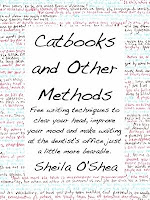
Two of my writing pals have published their work directly to Kindle, as so many authors are doing now. Will Kenyon's short stories, The Giant and The Littlest Goblin, are available for 99 cents at this link. If you like sci-fi and fantasy, these are quick, thought-provoking reads. Sheila O'Shea published Catbooks and Other Methods: Free Writing Techniques To Clear Your Head, Improve Your Mood and Make Waiting At the Dentist's Office Just a Little More Bearable, a useful and funny guide for writers. It's also just 99 cents at this link.
***
My Five Questions For... series kicks off next week with poet Justin Evans talking about his collection Town for the Trees. Also on deck in the coming weeks: Rupert Fike, Will Kenyon and Jeannine Hall Gailey.
***
Stephen Mills posted a lovely review of Slow To Burn at his blog, Joe's Jacket, yesterday. Here's an excerpt:
A few days ago, I sat down with the reprint edition of Kelley's chapbook Slow to Burn published by Seven Kitchens Press, and I quickly fell in love. In many ways, chapbooks can showcase a poet better than a full length book. Chapbooks, at their best, are tight and focused collections that don't rely on filler poems. Slow to Burn is exactly that.
You can read the entire review at this link.
***
My Five Questions For... series kicks off next week with poet Justin Evans talking about his collection Town for the Trees. Also on deck in the coming weeks: Rupert Fike, Will Kenyon and Jeannine Hall Gailey.
***
Stephen Mills posted a lovely review of Slow To Burn at his blog, Joe's Jacket, yesterday. Here's an excerpt:
A few days ago, I sat down with the reprint edition of Kelley's chapbook Slow to Burn published by Seven Kitchens Press, and I quickly fell in love. In many ways, chapbooks can showcase a poet better than a full length book. Chapbooks, at their best, are tight and focused collections that don't rely on filler poems. Slow to Burn is exactly that.
You can read the entire review at this link.
Monday, September 05, 2011
Blazing Away
BlazeVOX announced yesterday that it would close at the end of the year after it was revealed the press was asking poets to help subsidize the publication of their books. Today, the press changed its mind. This back-and-forth began when Brett Ortler wrote a long blog post about his dealings with BlazeVOX at Bark. Brett's book was accepted for publication and editor Geoffrey Gatza asked for a $250 donation to help with production costs.
In just a few days, the controversy spiraled with plenty of poets weighing in on how wrong this is, that BlazeVOX is a "vanity publisher" (it's not) and the revelation was another smirch on the grand tradition of poetry and publishing.
BlazeVOX has published some fine poets: Anne Waldman, Megan Volpert, Eileen Tabios, Christine Hamm, Daniel Nester, Didi Menendez, Amy King, Andrew Demcak and Kazim Ali to name a few. I have a number of the press' books in my library and I always thought they were well done. However, BlazeVOX made a misstep in not disclosing its co-operative publishing approach. It was only a matter of time before a poet made an issue of it, but the vile and derision heaped upon the press over the weekend is, sadly, typical of a certain part of the poetry "community" in America.
The fact is that many poets believe if you're not published by one of the indie darlings or one of the biggies like Knopf or Norton, you're an abject failure as a poet. This myth is perpetuated in academic circles and by poets who make a "career" hopscotching to residencies, who also subscribe to the "must win a first book contest" rule.
The publishing industry is having its ass handed to it on daily basis by writers circumventing agents and publishers to self-publish via ebook format and inexpensive printing options like Lulu. Poets who live and die by the academy are, for the most part, taking the hear no evil, see no evil, speak no evil stance against this publishing revolution. Those who have no interest in MFA and academic cultures just laugh and go on with making their art and disseminating by any means necessary.
BlazeVOX's lack of transparency is disappointing. The donation request should have been clearly stated in the submission guidelines. Gatza made an error in judgement, but the complete damnation of the press, which has produced some fine books over the years, is outrageous. Gatza has been called an illiterate, a scam artist and far worse in the comments on Ortler's blog and at HTML giant. Meanwhile, the icons of American poetry who have given awards to their friends, students and husbands are still on their pedestals, along with the complicit presses. In many ways, the BlazeVOX controversy says more about the "poety community" than it does about the press. It reveals deep insecurities, self-importance and fragile egos on the part of poets trying to "make it" in a niche part of literature.
I'm glad BlazeVOX has decided to stay in business, despite many of its supporters – and even a few poets published by the press – running in the other direction for fear it might damage their "reputations." Getting a book published by a press isn't easy. Many beloved indie presses now require a reading fee (Four Way Books is one) and poets spend hundreds or thousands of dollars in contest fees without batting an eye. Once a book is published, poets must purchase copies of their own books beyond the agreed upon number of author copies and the majority of marketing/touring will be coming out of the poet's own pocket. There is no free ride in publication and those who tell you otherwise are liars.
I hope BlazeVOX continues its tradition of publishing quirky and "weird" collections, but does so by being upfront about its policies. The press has worth and so do all the fine poets it has published in the past.
In just a few days, the controversy spiraled with plenty of poets weighing in on how wrong this is, that BlazeVOX is a "vanity publisher" (it's not) and the revelation was another smirch on the grand tradition of poetry and publishing.
BlazeVOX has published some fine poets: Anne Waldman, Megan Volpert, Eileen Tabios, Christine Hamm, Daniel Nester, Didi Menendez, Amy King, Andrew Demcak and Kazim Ali to name a few. I have a number of the press' books in my library and I always thought they were well done. However, BlazeVOX made a misstep in not disclosing its co-operative publishing approach. It was only a matter of time before a poet made an issue of it, but the vile and derision heaped upon the press over the weekend is, sadly, typical of a certain part of the poetry "community" in America.
The fact is that many poets believe if you're not published by one of the indie darlings or one of the biggies like Knopf or Norton, you're an abject failure as a poet. This myth is perpetuated in academic circles and by poets who make a "career" hopscotching to residencies, who also subscribe to the "must win a first book contest" rule.
The publishing industry is having its ass handed to it on daily basis by writers circumventing agents and publishers to self-publish via ebook format and inexpensive printing options like Lulu. Poets who live and die by the academy are, for the most part, taking the hear no evil, see no evil, speak no evil stance against this publishing revolution. Those who have no interest in MFA and academic cultures just laugh and go on with making their art and disseminating by any means necessary.
BlazeVOX's lack of transparency is disappointing. The donation request should have been clearly stated in the submission guidelines. Gatza made an error in judgement, but the complete damnation of the press, which has produced some fine books over the years, is outrageous. Gatza has been called an illiterate, a scam artist and far worse in the comments on Ortler's blog and at HTML giant. Meanwhile, the icons of American poetry who have given awards to their friends, students and husbands are still on their pedestals, along with the complicit presses. In many ways, the BlazeVOX controversy says more about the "poety community" than it does about the press. It reveals deep insecurities, self-importance and fragile egos on the part of poets trying to "make it" in a niche part of literature.
I'm glad BlazeVOX has decided to stay in business, despite many of its supporters – and even a few poets published by the press – running in the other direction for fear it might damage their "reputations." Getting a book published by a press isn't easy. Many beloved indie presses now require a reading fee (Four Way Books is one) and poets spend hundreds or thousands of dollars in contest fees without batting an eye. Once a book is published, poets must purchase copies of their own books beyond the agreed upon number of author copies and the majority of marketing/touring will be coming out of the poet's own pocket. There is no free ride in publication and those who tell you otherwise are liars.
I hope BlazeVOX continues its tradition of publishing quirky and "weird" collections, but does so by being upfront about its policies. The press has worth and so do all the fine poets it has published in the past.
Friday, September 02, 2011
Decatur Book Festival time again
The Decatur Book Festival is officially underway and 80,000 people are expected to attend this weekend-long literary orgy.
Tomorrow, I have the pleasure of introducing Jericho Brown at his reading at Eddie's Attic at 3 p.m. On Sunday, I read from Slow To Burn with the fab Michael Montlack, who will be reading from his new collection, Cool Limbo, at 1:15 p.m. also at Eddie's Attic.
On Sunday, I'm hosting two hours of poets from 4-6 p.m. on the Local Poetry Stage at Java Monkey Coffee House. At 8 p.m., we'll have the official release for Java Monkey Speaks: A Poetry Anthology Vol. 4, which I edited with Kodac Harrison. The featured reading will be by Pulitzer Prize-winning poet Natasha Trethewey, who has a new poem in the anthology.
To find our more about all the events happening this weekend in Decatur, visit www.decaturbookfestival.com.
Tomorrow, I have the pleasure of introducing Jericho Brown at his reading at Eddie's Attic at 3 p.m. On Sunday, I read from Slow To Burn with the fab Michael Montlack, who will be reading from his new collection, Cool Limbo, at 1:15 p.m. also at Eddie's Attic.
On Sunday, I'm hosting two hours of poets from 4-6 p.m. on the Local Poetry Stage at Java Monkey Coffee House. At 8 p.m., we'll have the official release for Java Monkey Speaks: A Poetry Anthology Vol. 4, which I edited with Kodac Harrison. The featured reading will be by Pulitzer Prize-winning poet Natasha Trethewey, who has a new poem in the anthology.
To find our more about all the events happening this weekend in Decatur, visit www.decaturbookfestival.com.
Thursday, September 01, 2011
"Remain In Light" ebook coming in October
The ebook version of Remain In Light is scheduled for the first
week of October! The novel will be available at Amazon Kindle, Barnes
& Noble Nook, Smashwords and other ebook outlets. The trade paperback is still planned for January. Stay tuned for
more details from Vanilla Heart Publishing on the release!
If anyone would like a copy of the digital ARC of the novel to preview/review at your blog, website or in a publication (print or online), drop me an email at collinkelley@gmail.com. I'm also working on setting up a blog tour, so if you're looking for guest posts or might be interested in interviewing me, posting an excerpt, etc. let me know.
Subscribe to:
Posts (Atom)
Collin Kelley: Modern Confessional
Welcome to Collin Kelley: Modern Confessional, the website for poet, novelist, playwright and journalist Collin Kelley.